
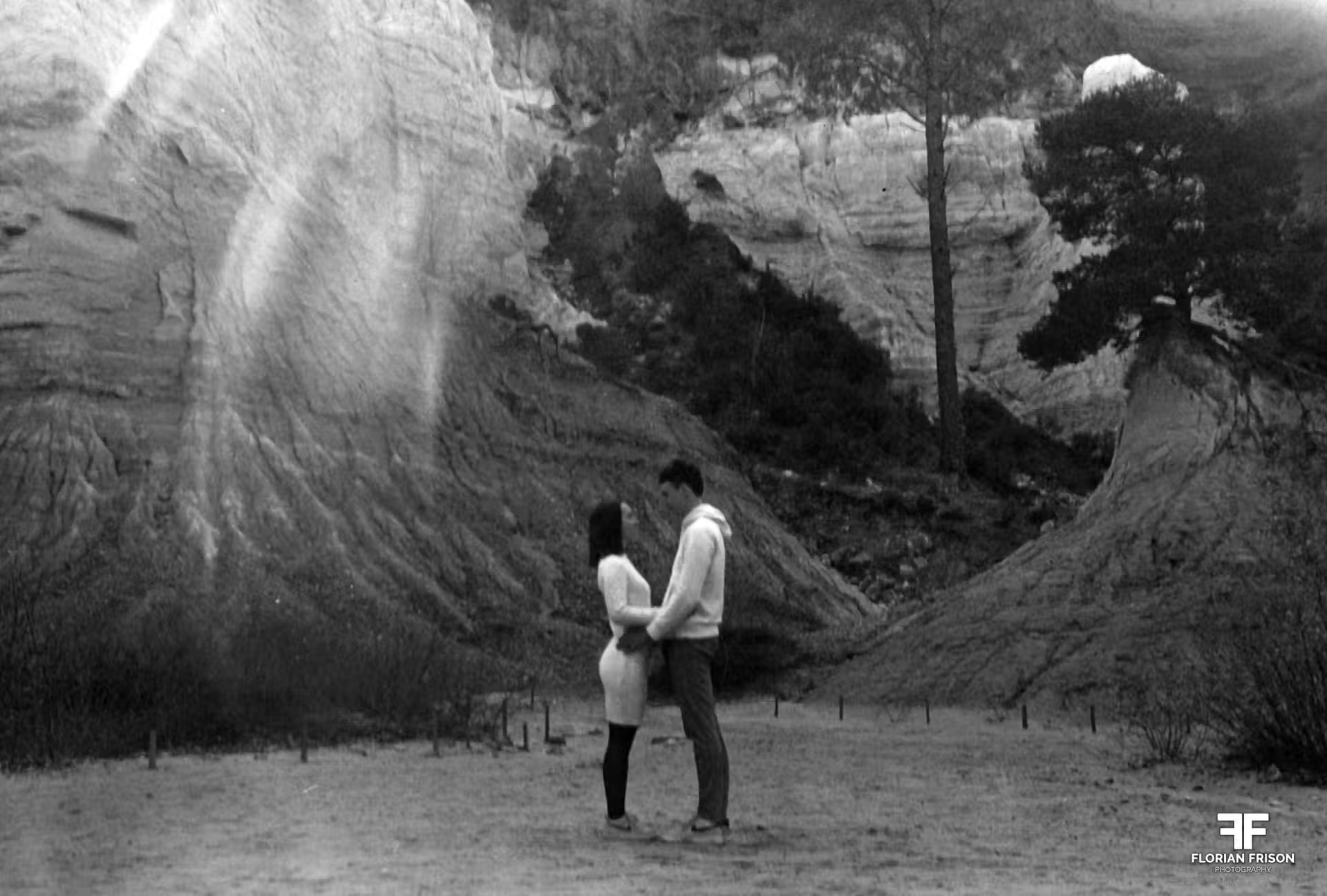
A Mechanical Heritage Filled with Memories
The story of this peculiar machine truly began for me in 2020. Following the passing of my grandfather, this camera, loaded with memories and family history, was carefully passed down to me. It is a Lumière 6.5 x 11, an authentic mechanical marvel straight out of the 1950s.
Holding it in my hands immediately gave me a unique feeling. Rather than relegating it to a mere decorative object on a shelf, I made a decision: I was going to restore it to working order so that it could, once again, capture light.
You can actually read the detailed story of this rediscovery on my Flotographie blog..
The Clash of Worlds: Nikon Z8 / Z6 III vs. Lumière 6.5 x 11
As a professional wedding and portrait photographer, my daily life is paced by the use of cutting-edge hybrid cameras, such as the Nikon Z8 and the brand-new Z6 III. The contrast with this venerable post-war camera is absolutely striking, and switching from one to the other requires real mental gymnastics.
Take sharpness, for example. My Nikon bodies lock onto a subject's eye in a fraction of a second, tracking their slightest movement with deadly precision. On the Lumière, focusing is done completely blind. The viewfinder, which is only used for framing, is absolutely not connected to the lens. You therefore have to estimate the distance between yourself and the subject with your naked eye, then manually turn the lens dial to 1 meter, 3 meters, or 5 meters. The slightest error in judgment, and the photograph is irreparably blurry.
There is also this relationship with time and quantity that completely changes. Where my Z8 can freeze action at dozens of frames per second while securing thousands of shots on its dual memory card slots, vintage film imposes absolute rigor and patience. A roll of film loaded into this Lumière gives me the right to a total of only 4 or 5 photos. Every fully mechanical shutter release is definitive and costly. It requires long minutes of preparation to advance the film, cock the shutter, estimate the light, and set the aperture.
The Struggles of Restoration (The Art of Tinkering)
Making such an antique work today is a true obstacle course. I had the opportunity to share the extent of these struggles on Flotographie, but the first hurdle was simply feeding it.
This camera originally used 116 format film, a standard that has completely disappeared from circulation. The only viable alternative was to use current, slightly smaller 120 format film with the help of specific adapters. Without these precious accessories during my very first attempts, I faced major light leaks that ruined my images.
Then came the problem of film advancement. The "actinic window," that small red glass on the back of the camera meant to show you the frame number, is positioned for the 116 format. With my 120 film, the numbers simply don't line up. At first, I was advancing the film blind, which inevitably led to overlapping images. To fix this, I engineered a true DIY system with the help of my other grandfather: we wrapped newspaper around the take-up spool to mathematically count the number of dial turns needed. The trick worked to separate the frames, but at the cost of a huge loss of usable surface on the film.
Final Adjustments Before the Big Test
Today, I still can't say the camera is 100% operational, but I'm getting close.
To overcome this famous loss of film space, my partner lab (Photo Studio in Salon-de-Provence) kindly provided me with scraps of backing paper from old rolls of film. Last week, I was able to run much more rigorous "dry" tests to finally try and determine the perfect number of dial turns. But film photography is always full of surprises: even with this method, I have a strong feeling that the tension and advancement differ depending on the brand of film used!
Usually, I feed this camera with Ilford 120 Black and White (100 or 400 ISO). However, for my very next challenge, I decided to test a Foma Fomapan Action 120 film at 400 ISO, known for offering a more contrasted look.
Why all this meticulous preparation? Simply because a photo session with a professional model is currently being prepared. Although this shoot unfortunately had to be postponed for health reasons, it is still very much on the agenda. It will be the perfect opportunity to take this machine out into the field: alongside my usual work with my digital hybrids, I plan to take these 4 or 5 unique shots with this historical camera.
We will see if the magic happens and if my dial calculations finally pay off. Stay tuned, the result of this timeless session will be revealed in Episode 2!
0 Comments